Red, black, white

The flags of the Sbandieratori di Assisi

Five generations of cloths, four banners, five costumes: the identity of the Group, since 1975.

A pole, a cloth, some lead, insulating tape and a lot of patience. The flags of the Sbandieratori di Assisi, designed by Francesco Mancinelli, have changed over the decades in shape, technique and blazon, but they have always kept three colours: red, black and white.

How a flag is made

The pole, from the Latin hasta, “spear”: for the flag-waver it is what the sword is for the knight. The cloth is a very light square fabric with a channel to slide it onto the pole, reinforcements at the grip and at the tip, and small decorative tassels. And then the lead: a weight inserted in the handle that moves the centre of gravity towards the point where the cloth begins. It lengthens the throw and guides the flag, which lines up with the handle forward and the cloth behind. Without the lead the show would not be a show.

The first flags were hand-painted, one mythological animal for each flag-waver, the same one embroidered on the costume: lion, horse, eagle, two-headed eagle, dragon, bull, unicorn. The cloths were designed by the flag-wavers themselves and made with the help of mothers of good will; the clumsiest ones spilled the paint pot, creating “interesting abstract works à la Pollock”. Since 1984 the flags have had their current printed look.

Five generations

The cloths, from 1975 to today

First generation

1975

First generation

The first generation was bought in Sansepolcro: heavy, unsuitable flags with applied fabric decorations, used for athletic training at the end of 1975. The first real generation was hand-painted with fabric markers: bendy, with one red mythological animal per flag-waver. For the “Pair”, two flags with a quartered blazon and inverted colours were designed.

Second generation

1979

Second generation

A freer use of quartering: in 1979 a black border, red bars on white and a red rampant lion in an old French shield. In 1980 the flag with the standard-bearing lion, with black and red bands and stylised lion heads.

Third generation

1982

Third generation

White flags with an old French shield with blue and gold lozenges, topped by a silver helm with a lily-crown and red and black mantling. In the second edition an outer frame is added.

Fourth generation

1984

Fourth generation

Flags with a black or red border: with the black border, red bars and a red rampant lion; with the red border, black bars and a black rampant lion.

Fifth generation

1988

Fifth generation

Since 1984 the current printed look: white flags, in the first field the red roundel with the coat of arms of the Municipality of Assisi (black cross and red rampant lion) flanked by acanthus leaves; in the second red and black triangles, with the black-triangle border. Hand-painting continues nonetheless, in emergencies.

Flag of the Sbandieratori di Assisi
The mythological animals drawn in 1976 by Luciano Bernasconi for the first flags

For the fiftieth anniversary

The flags of the 50th

For the fiftieth anniversary the original flags were reproduced with today’s prints and fabrics.

Flag of the Sbandieratori di Assisi for the 50th anniversary
1975
Flag of the Sbandieratori di Assisi for the 50th anniversary
1979
Flag of the Sbandieratori di Assisi for the 50th anniversary
2025
Flag of the Sbandieratori di Assisi for the 50th anniversary
Assisi 1223–2023

The banners

The Group’s gonfalons

In Calendimaggio jargon the gonfalons are called “stendardi”. There have been four.

First banner

1976

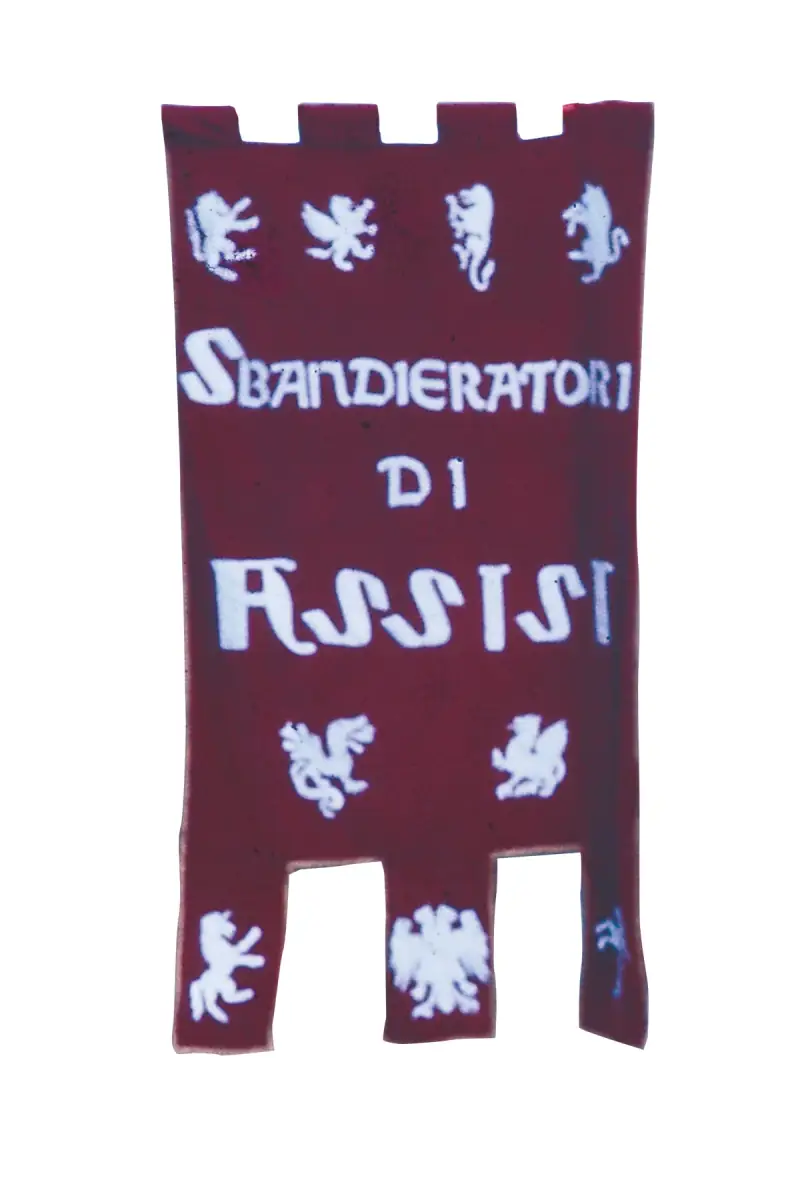
First banner

Bordeaux, with white rampant animals: horse, Pegasus, lizard, unicorn, amphisbaena, dragon, bull, two-headed eagle, ibex.

Second banner

1979

Second banner

Divided blue and red, with the coat of arms of the Municipality of Assisi (silver cross on blue, golden lion on red) topped and supported by eight old French shields.

Third banner

1982

Third banner

Red, with the municipal cross and lion in two shields, and black bands at the corners.

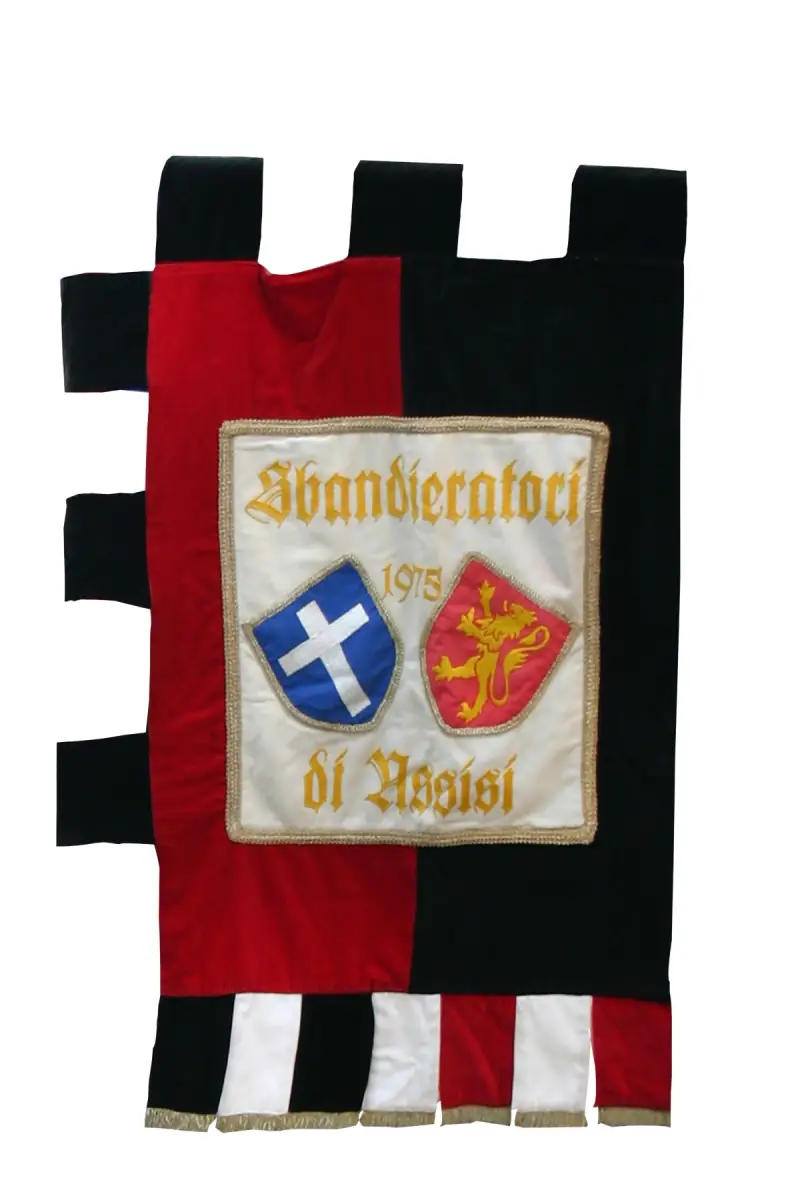
Fourth banner

1988

Fourth banner

Divided red and black, with the municipal cross and lion in two shields: it is the current banner.

The costumes

Five costumes in fifty years

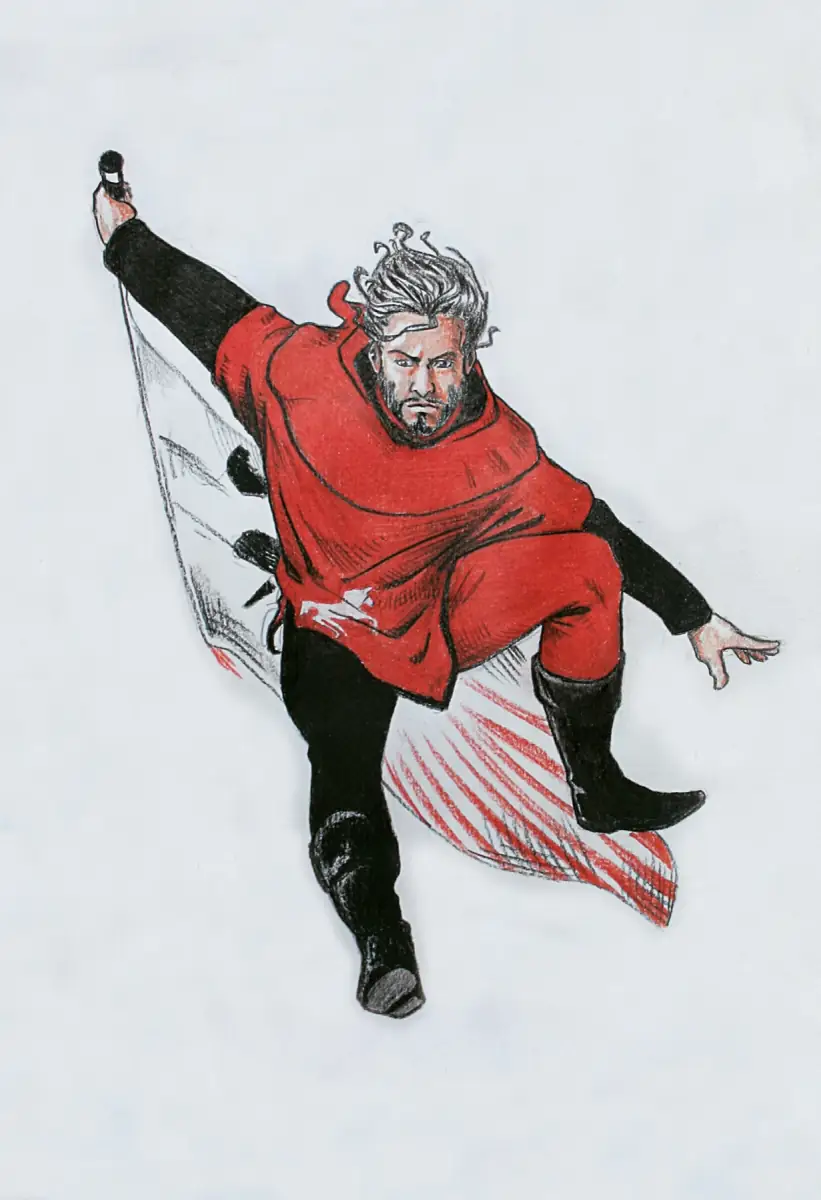
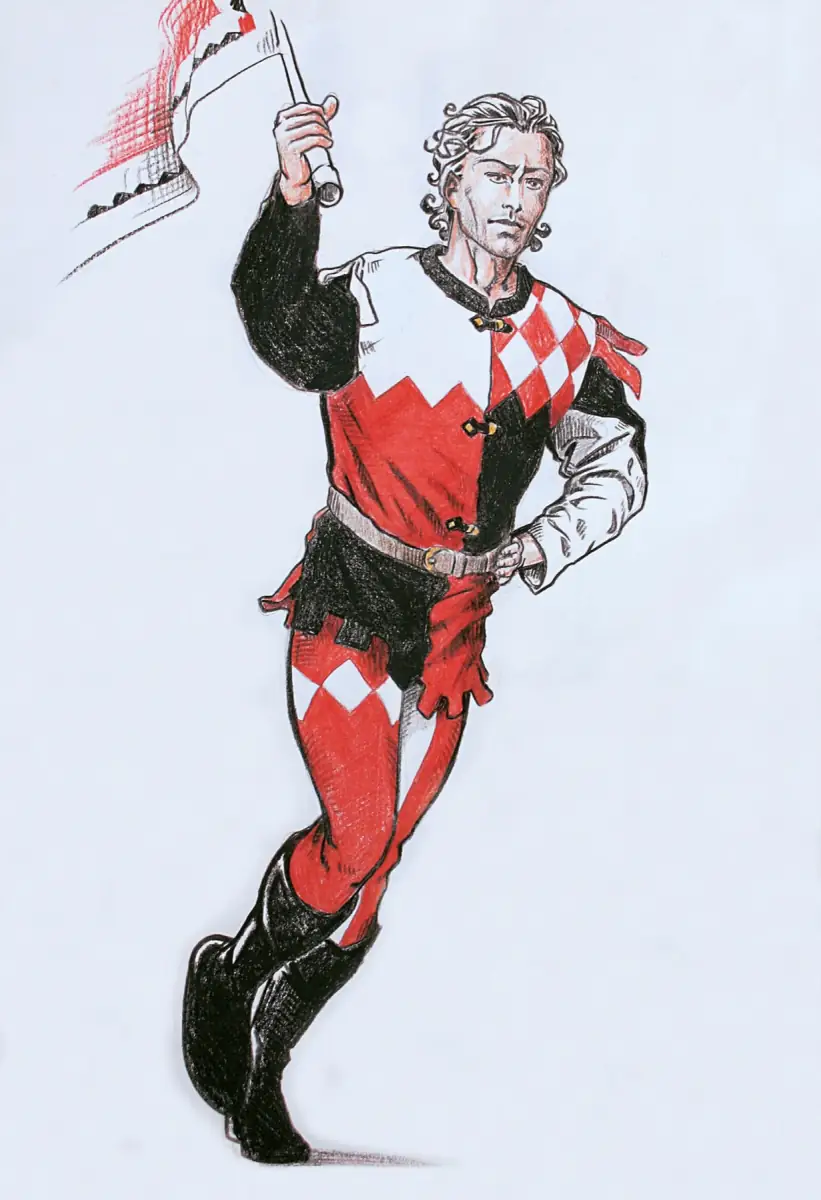
From the “generic Middle Ages” of 1976 to a balance between historical accuracy, stage and practicality. Illustrations by Marco Bovi.

The first costume

1976

The first costume

Designed by the painter Luciano Bernasconi and sewn by Bruno Tanci, tailor of the Parte de Sotto. Tunic and hood in red wool cloth, black sleeves, hose half black and half red, an embroidered animal chosen by each flag-waver and repeated on the flag. The drummers in two-tone red and black cloth.

The second costume

1982

The second costume

Designed by Francesco Mancinelli and made by Bruno Tanci: it marked the Group’s independence from the Parte de Sotto. Light red velvet doublet, black hose flamed with white and red, decoration in white cloth with squares and oblique bands.

The third costume

1989

The third costume

Commissioned from the theatre costume designer Giancarlo Colis of Spoleto: black and red cotton velvet, front opening like a “medieval brigandine” with leather frogs, black-on-white and red flaming, leather belt.

The fourth costume

1995

The fourth costume

Again by Giancarlo Colis, who introduces fustian: three inlays with diamonds, squares and oblique cuts, a skirt quartered in three colours with a Guelph-battlement edge.

The fifth costume

2001

The fifth costume

By the master tailor Giorgio Tani, it brings together the best elements of aesthetics and practicality tried out in twenty-five years: sleeveless tunic with the lion from Assisi’s coat of arms embroidered in gold on the chest, skirt with Guelph battlements, three white flames on a red field. The shirt is in honeycomb fabric. Today the models have been revisited by Daniele Gelsi.

Hire the group

Bring the Assisi School to your square

Festivals, historical re-enactments, official events, weddings and shows in Italy and abroad.

Book the show